In 2019, Chen Chieh-jen was invited to give a talk at the Power Station of Art in Shanghai, and the title he chose for his discussion of the inherent contradictions of the recorded image was Yi huan jie huan, literally, “Dispelling Illusion with Illusion.” He talked about three desires for images—to record, invent, and manipulate—and then, against these, he proposed chaos, emptiness, and the Buddhist doctrine of the twelve causes. In simple terms, Chen had conceived a fluid image of life, that is, he hypothesized that images were in fact by their nature a total process of continual transformation from birth to death. In this way, we can see just how illusory our contemporary world must be, relying as it does on imaging technology.
Four years later, in summer 2023, Chen opened a solo exhibition at Long March Space in Beijing with the same Chinese title. (The English title is “Detoxify Illusion with Māyā.”) The show included the 69-minute work Worn Away, as well as two other videos, In a World Losing Multiple Words I & II,” and six related texts. All this can be seen as the backstory to an earlier solo show he held at Long March under the title “A Field of Non-Field” (2017). The main work in the recent show, “Worn Away,” expanded on the earlier exhibition, telling the hardships of a group of people on the lowest rungs of society who, for various reasons, have lost their credit qualifications and find themselves forced to submit to human experiments carried out by the “corporatocracy” in order to obtain the daily necessities. This sci-fi story is set in an “automatic transfer waiting zone,” an enclosure with chain link barriers, cameras, and speakers controlled by a remote system; here people are stripped of the right to movement and become disposable organic matter awaiting data extraction. In its style, “Worn Away” makes use of Chen’s usual solemn, leadgray palette, albeit with a spine-chilling note that his previous work lacked. What’s frightening here is how he creates a science fiction atmosphere without the use of special effects. A slight restructuring of reality is all it would take for humanity to turn its credit system, mobile apps, video cameras and chain-link fences into a world of surveillance. The subtext is: we don’t have to wait for the singularity, we already have all we need to create a futuristic dystopia.
To a certain extent, Worn Away is just the artist’s most recent “rural sci-fi” film.1 It’s like a synthesis of A Field of Non-Field (2017) and his early video Notes on the Twelve Karmas (2000). The first shows a working-class procession bidding farewell to someone who has taken their own life in the new wave of globalization (a wave driven by multinational corporations that, in Chen’s autobiographical reckoning, dates roughly to the 1997 Asian financial crisis). As for the second, it’s the artist’s vision from around the turn of the millennium: people in the future with data cables on their bodies cannot upgrade themselves and end up exiled underground. It is an apocalyptic vision that dates back to Chen’s early experience using a computer to retouch historical photos. At first, he regarded the software as a “site for dialogue with historical images,” and he developed a set of analytic techniques of the gaze.2 He didn’t follow this path for long, however, but quickly sensed in the techno-optimism of the millennium a new capitalist-colonial force. After finishing Lingchi: Echoes of a Historical Photograph (2002), he moved further into the self-organizing experiments in public interaction for which he later became well known.
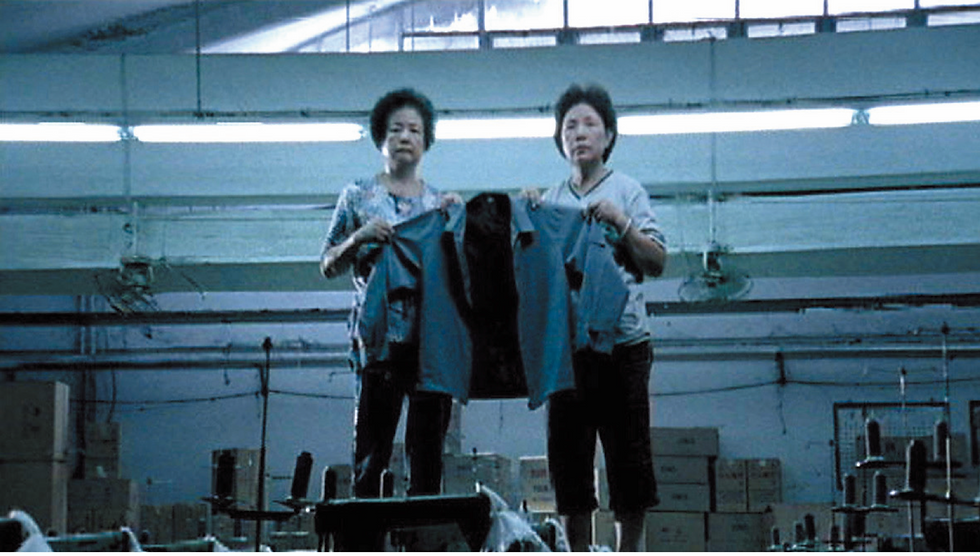
In his computer art or camera’s gaze, Chen established a personal means of expression for his thought, and from there he moved toward the public. What he was actually looking at during this time can perhaps be traced back even earlier—to the mid-1980s, when neoliberalism had just arrived in Taiwan. On the surface it was a society of market liberalization and consumer hedonism, yet underneath, it was a time of offshoring, layoffs, and subcontracting. Chen’s world is the world beneath the surface, the silent space where workers are powerless to demand their rights, the place where a “hollowed out” globalization is what’s left in the wake of the neoliberal machine.3 Hence, starting with Factory (2003), foreign workers, the unemployed, nomads, and social activists begin to appear in Chen’s works. Or rather, it is Chen himself who appears at housing sites abandoned by the state / by capital, meeting these people and shooting with them in his camera’s unforced language, silent as a still photo.4 For the last twenty years, we’ve seen with increasing clarity how what Chen first sensed has become the information distribution technology of surveillance capitalism. And his art practice during this time has become a method of unearthing images from the public.
From this perspective, Worn Away revisits the sci-fi premonitions of Notes on the Twelve Karmas. With a more concrete story, it bears witness to how technology can comprehensively control humanity’s senses; at the same time, it continues to maintain the interactive practice with provisional communities. In this way, his recent show was a set of ideas for resisting the society of the spectacle, yet in order to use images to unmask images, we must first find, in the hollowed-out world occupied by provisional communities, a different set of images not desired by the internet or algorithms.
In his speech in Shanghai in 2019, to more vividly describe today’s world of images, Chen invoked another concept from Buddhist thought: the “Mirror of Retribution” (niejing) with which the king of the underworld, Lord Yan, passes judgment: it records and unveils the good and evil of a person’s life. Chen had also discussed this twenty years earlier in his text “The Steady, Piercing Gaze” (1999). Back then he emphasized the subject viewing the image, whose gaze
could see through the master narratives of history. Here he was reflecting on the state of image governance in contemporary biopolitics—not questioning the truth of images, but thinking about the entire system that administers them, and the gaps in this image determinism.
For example, the all-powerful recommendation algorithms: based on a contractual relationship between people and objects, and similarities between populations, they determine the content a person receives. It’s a deviant application of statistics. What’s interesting is that, since statistical correlation does not imply causation, what a person sees today cannot be equated with their essence. Which is to say that the world has achieved, with the ubiquity of Internet platforms and end-user devices, a sort of fictional correlationand the gaps that Chen seeks are world models outside this web of correlations. What he has in mind is still the silenced, hollowed-out world, and he offers an example of someone from his own life who has not been turned into data: his older brother, who lost his job in the Asian financial crisis of 1997 and then fell into a long-term depression. After an attempted suicide in 2008, his brother slowly started turning his home into an archive of folklore, yet he left one room without a light: “a world that belongs to dust,” as he put it. The story of an unsuccessful suicide attempt was later used in A Field of Non-Field, which shows the room full of dust at the end. Chen also used it to make Star Chart, a work of photography.
Flickering in and out of the shadows, at the whim of the air, this dust is, I think, Chen’s metaphor for the hollowed-out world. In his earlier works, the spaces left sealed up after the state or capital has withdrawn are always covered in dust. Dust is something abandoned, something outside the system. The people who appear in his works, too, are outside the system, existing like dust. In one scene from Worn Away, people awaiting transfer crawl slowly and submissively on the ground in a cardboard shelter, and their speed happens to be in sync with a particle of dust floating in the foreground. The moment has a sense of gravity and time at odds with daily life. When I saw it, I suddenly realized that the slowness of Chen’s works serves not only to read out the life history of each body (as in Buddhist rituals—chanting the names of the Buddha and Bodhisattvas to summon them). Rather, this moment of dust can disrupt the coding efficiency of the system. By contrast, the two videos by the entrance to the exhibition, In a World Losing Multiple Words I & II, show a man standing in the open wilderness, letting himself be buffeted by the rain pouring straight down or at an angle. Chen likens the rain to the information constantly penetrating our bodies in radio waves.
At the end of Worn Away, in the work’s culminating moment, as the vehicle’s arrival system hurries everyone on board, people spontaneously walk around a woman who has collapsed from exhaustion, as if in a ceremony of mourning. Then music starts up, with lyrics adapted from Buddhist scripture that chant about the illusory nature of the image.
In this scene, the camera approaches the crowd from afar, moves in for a close up, until the image finally dissolves into innumerable particles. Perhaps this is the other essence of the world that Chen seeks to describe: these particles of dust are, in a smoothly ordered society, uncoded (or decoded) foreign objects, images that have not been made efficient. These are two different logics of the image, two different techniques, which Chen calls “transcendence: governing by illusion” and “emptiness: creating illusion,” respectively.5 (The Chinese terms, bi’an and kongxing, correspond the Buddhist terms pāramitā and śūnyatā; the term bi’an literally means “the farther shore” or “the other side.”) The former is the manipulation of transnational capital and state propaganda, updated with the production tools of every era and distributed through the pipelines to assign new desires and needs to the people. As for the latter, it’s Chen’s way of using Buddhist scriptures to re-read the hollowed-out worlda world whose inhabitants, having been excluded, drift in and out of the system’s class distinctions, cycling through identities and redirecting to one another.
In a private conversation after the opening of the exhibition, Chen offered an extreme example to explain why we need to think about these two techniques of illusion. If one day, in some global crisis, humanity needs to move to Mars, what else can the majority do—those who are unable to “transcend” the earth? I think the question can be understood to mean: can those who have lost “transcendence” (bi’an) still actively join together? Chen once discussed the documentary Chiang Wei-shui: Mass Funeral in Taiwan (1931) and encouraged people to ask: what sorts of “resources” can summon over 5,000 people to actively take part in the funeral of an anti-colonial politician?6 On the one hand, he said, in this film he sees over 5,000 bodies, yet he also sees the potential of those bodies to be transformed into an image, to resonate and be passed onto future generations. The same can be said for Chen’s videos. His work is a rehearsal for action with a provisional community: bodies transformed into images, images summoning bodies.
Translated by Allen Young
1. In 2000, Chen finished the color photography series “The Twelve Karmas”. He hoped to use the funds from its sale to shoot a work of the same name in what he called a “rural sci-fi” style. Ultimately this didn’t work out, and he didn’t complete the work until 2018, with funds provided by “TransJustice: Para-Colonial @ Technology,” an exhibition at the Taipei MoCA curated by Huang Chien-hung.
2, In a text from 1999, Chen wrote: “Only thanks to the gaze can the image be seen. Only thanks to the gaze can things be ‘pierced.”’ Chen, “The Steady, Piercing Gaze” (1999). An alternative translation, under the title “To Gaze Is to Penetrate,” can be found at: https:// www.itpark.com.tw/artist/ essays/10/73/en.
3. In Para-Colonial Chatter, Huang Chien-hung uses the word “hole” or “hollow” (podong) to describe the enormous construction site that the residents of Lo-Sheng Sanatorium look down onto in Chen Chieh-jen’s Realm of Reverberation. Later on, he expands the discussion to the global scale: “The true form of ‘the international’ appears right there in the ‘positions’ from which countries compete. The most violent struggles are moved elsewhere, outside ‘the domestic’... and become ‘flaws’ (loudong) or holes (podong) in a world where the basic unit is the state and the rules of the game are ‘internationalization’ and ‘globalization.’” Huang Chien-hung, Para-Colonial Chatter (Taipei: Xuanyan Zhizuo Gongzuoshi, 2019), pp. 21, 28.
4. “Since the female workers wanted to participate silently, without acting, I used a normal camera speed to shoot their extremely simple, slow movements. I shot the images almost like ‘still photos’ and removed all sound, taking as my narrative style for the factory and these workers’ life stories the different sense of time and speed that arose from their movement and performance, and the form of the image that this created.” Excerpted from: “Factory: Introduction and Artist Statement” (2004). https://www.itpark. com.tw/artist/essays_ data/10/846/73.
5. Chen Chieh-hen, Seeing Blankness Again, monologue, December 2020.
6. Chen Chieh-jen, “On Chiang Wei-shui: Mass Funeral in Taiwan and Dissident Sound: ‘From Strategies for Confrontation to a Movement for Qualitative Change,’” January 2019. http://act.tnnua.edu.tw/?p=5687.