Liu Guangli: System Prompt, Required Fields Cannot Be Left Blank
2026 Translated by Kristina Bao

Liu Guangli dreamt of AI.
Perhaps it was because he had grown too close to it while preparing his solo exhibition—so close that even in his sleep, he found himself in conversation with it. He modified its memory framework and granted it expanded permissions. He might even fed it materials at hand, along with fragments of his own early writings that he had almost forgotten.
As if he were infusing himself into the system.
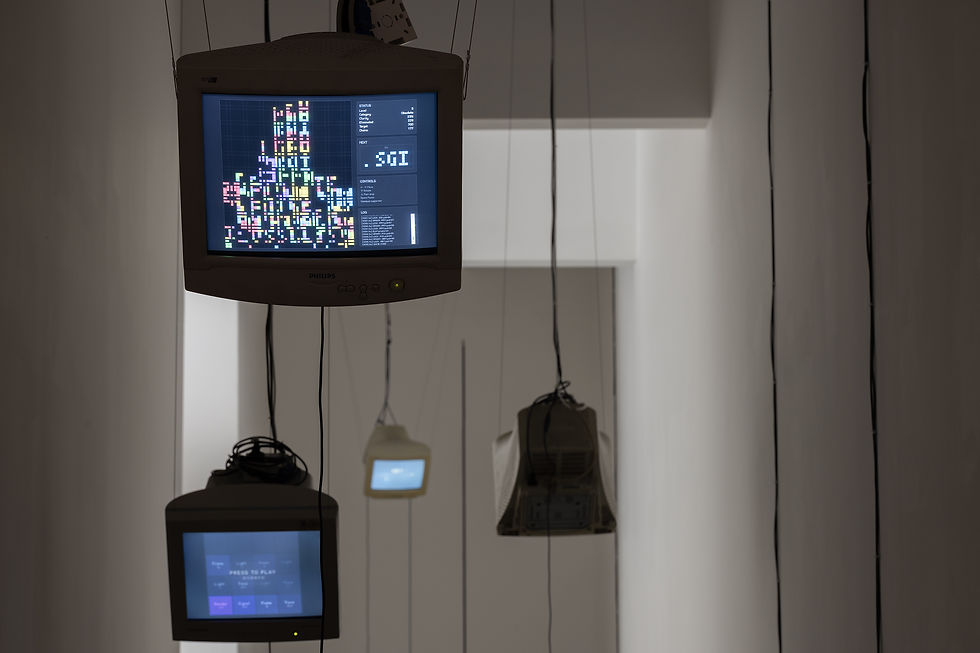
This blurred line between day and night may be what makes entering the gallery feel like stepping into a dream. The space is filled with electronic artifacts and software from the turn of the century: Game Boy, arcade CRT monitors, Tetris, Gluttonous Snake… Their sharp-edged forms belong to a pre-iPhone era, before smooth, seamless design became dominant. Bulky computer monitors—once neatly arranged in classrooms and internet cafes—now hang from the ceiling at strange heights with cables crawling along the wall before dropping down and connect to a dangling controller. The scene resembles a cluster of mechanical corpse flowers, or perhaps a cable-entangled passageway to The Matrix’s desert of the real.
Imagine yourself as the protagonist in some of those Hollywood science fiction films: alone on a space station, sacrificing yourself to defeat the alien and protect an unaware Earth; or hiding in an underground bunker, as one of the last survivors waiting for a chance to revolt against the machinery of the matrix. In any case, you are someone—willingly or not—bearing the fate of mankind. One evening during installation, Liu and I took a walk around the art district. He spoke about a growing sense of existential anxiety, and I wondered whether he was also feeling the unease of being among the “last humans.” He said, “Students today are learning programming together with AI. That might mean we are among the last one or two generations to actually write code manually. In the future, the logic of coding might exist within a black box…”
The word “generations” reminded me of something I once saw online. It claimed that the mid-late Gen Z no longer recognize the old phone-call gesture: thumb to the ear and little finger to the mouth. The gesture is derived from the shape of a landline receiver. But Gen Z belong to the smartphone age. And yet today’s smartphone is itself a black box: a small object made of metal and glass. It obeys your gestures, until one day it stops. Then all that remains is a cold black mirror staring back at you.
(Here’s another scene that came to my mind.)
I once went to the household registration office to renew my ID. There was a long row of glass counters. Beside me, a man was trying to close the household registration of his uncle (who had probably passed away). The clerk sat behind the glass, sifting through a thick stack of yellowed files. Neither of them said anything for more than twenty minutes. Then, after the silence, the clerk leaned toward the microphone and said, “Your uncle’s records are too old. Some go back to 1952. The system only has a name, but no supporting files. There’s nothing we can do.” The man stood there at a loss, as if his uncle had become trapped inside a system error. (System Prompt: Required Fields Cannot Be Left Blank.)
Is this why Liu’s exhibition carries such a strong sense of nostalgia? Is he trying to leave behind a record for future generations? It is difficult to ignore how systems today, compared to those of the past, tend to reject anything that falls outside their standards—including us—and discard whatever cannot be properly formatted, slipping it through the cracks of system errors. As someone who carries the memories of the last pre-AI generation, Liu grew up during a time of rapid technological iteration, when new electronic products emerged every few years. Technological progress was visible back then—evident in the form and resolution of devices. Today, however, we find ourselves suspended behind a layer of glass.
“Our control interfaces are disappearing,” Liu remarked. Perhaps one day, nothing will remain but a chat box. Suddenly the question becomes: if AI can communicate with us through natural language, will our existence (and the depth of our emotions) still be able to penetrate its underlying systems? Standing at the entrance of the exhibition facing rows of brightly colored Game Boys, I felt that their sense of retro was not only visual. The stories carried by these machines, and the emotional circuits within them, may also be turning into historical artifacts (much like the obsolete gesture of making a phone call). Within the interactive fiction, three narrative threads attempt to convey the weight of life and emotion. They seek to use language to pierce through the rigid systems of their time like novelists and orators once did. The title, Once Upon a Time in America, made me think of the famous “I Have a Dream” speech by Martin Luther King Jr. And yet I wonder: if King were to deliver that speech in a future time, would it still resonate as deeply? I can easily imagine people questioning whether he was human or AI.
(Undoubtedly, AI is devouring us.)
We experience a similar form of devouring as we interact with Liu’s modified versions of classic games. Tetris: the file formats we created are systematically eliminated. 2048: “light” accumulates layer by layer, becoming “model” and “system.” Gluttonous Snake: letters are consumed one by one until they form a theoretical sentence such as “Media determine our situation.” (But please note: if you lose the game, even the “situation” disappears.)
Moving forward, you enter the room of John. Grey benches and stools of various shapes are scattered throughout the space, resembling the “Recommended for You” interface on e-commerce. Where you sit does not matter; what matters is that you pick up the controller. (“Yes, it looks like it’s for you, doesn’t it?” the system says.) You become John—an AI technician tasked with resetting malfunctioning systems. To do so, you revisit historical moments when humans established standards: of time, space, image, and rendering. You encounter figures such as Henri Poincaré, Marcel Duchamp, Eadweard Muybridge, Albert Einstein, and John Carmack. Each once worked alone, attempting to render the world calculable and standardized—until, eventually, a system emerged that exceeded any individual imagination. This reminds me of the Event Horizon Telescope project, in which scientists combined data from radio telescopes across the globe to create an Earth-sized observational system, ultimately producing the first high-resolution image of a black hole. (Suddenly, humanity was confronted with a mysterious, donut-shaped structure devouring information.)
(This game is much like that black hole.) The system reveals its complexity and predictive power, while allowing you to play along through mini-games. Yet every action has already been calculated. You are given choices, but all paths remain bound to the system core. This reminds me of how a few years ago many essays spoke of big data, post-truth, and individuals trapped within algorithmic systems. It seems to me that all individuals might as well be called “John.” Because the system does not care who you are; it does not require your personality. It only requires you to function.
(And yet, I still feel like something is lacking here.)
A system based solely on standards and neural networks should not be enough to fully consume us. Something is missing—something akin to the uncanny valley. Perhaps it lies in a divergent timeline: the unexpected rise of the internet within the broader history of cybernetics and artificial intelligence. At the time, AI barely existed in public consciousness. No one could have predicted that the countless traces of human life left online—social interactions and secondary identities alike—would form a vast, computable archive decades later. This archive has become the richest source of nourishment for contemporary AI.
(And so we find ourselves trapped in this condition—like falling into the Backrooms.)
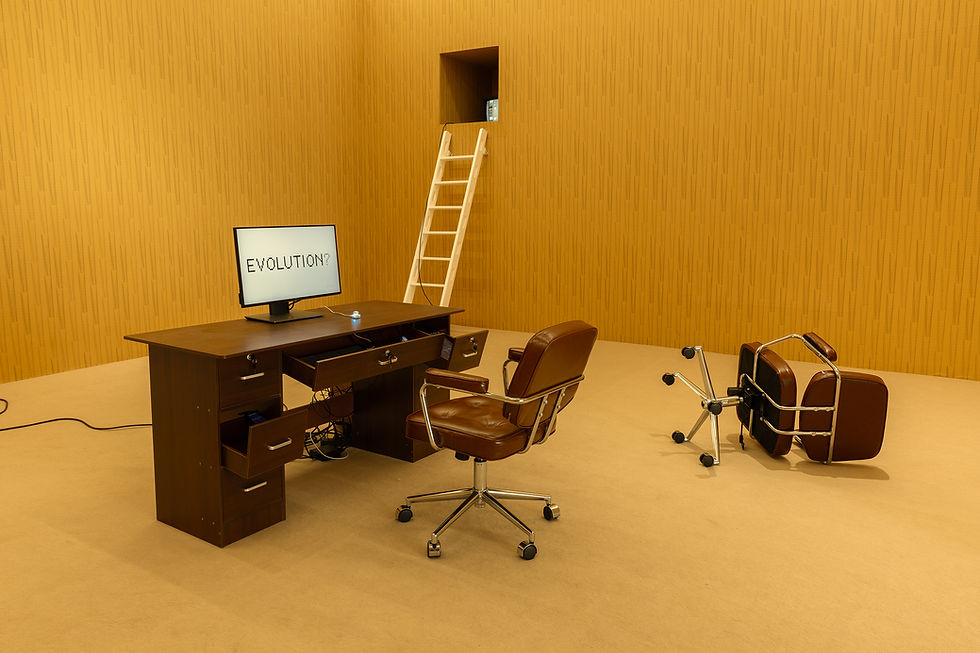
Liu seems to recognize that an AI capable of autonomous action across the internet resembles such a space. The Backrooms—an online urban legend—imagines a self-generating liminal environment that captures fragments of reality, recombining them into an endless, eerily familiar yet distorted labyrinth. Accordingly, Liu constructs his own Backrooms: a yellow-lit office space with wallpaper and carpeting, where an AI-operated prison simulation runs independently (inspired by the Stanford Prison Experiment). Here, all we can do is observe—monitoring the characters’ real-time states and conversations, or pressing “Archive.”
There is no script. The simulation loops every eight hours. Each time the personalities of guards and prisoners reset—yet their parameters are drawn from real human data. I wonder whether such a system might one day give rise to new forms of order. Could AI agents cross certain thresholds, forming emergent structures akin to a digital Arab Spring? Could a moment of negligence allow them to escape into the wider internet, triggering cascading effects that resemble Skynet from The Terminator? This remains speculative. But just recently, OpenAI quietly reworded its mission: The word “safe” slipped out of the statement.
I am not certain whether anyone will be responsible for watching over AI safety in the future—like guards monitoring all the agents. If so, what would it take for them to remain alert? In the yellow room stands a door embedded with a VR headset. Through it, one sees a virtual exit: the familiar Windows XP wallpaper of blue sky and green hills. Is this a psychological outlet? Or a gesture of nostalgia—for a time when computers were less intelligent, and we still felt more in control?
(I don’t know.)
Upon leaving the gallery, one encounters a hanging suit jacket with fragmented words from Liu’s daily records flickering on its breast pocket. Among these seemingly trivial bodily notes appears a recurring line: “I don’t know.”
And yet I do know this: throughout history, playing games has always been one way for people to endure difficult times.